UX CASE STUDY
Making advisor discovery feel clearer and more trustworthy
Anyone helps people access advice through quick calls with experienced advisors. I redesigned the advisor discovery experience to reduce uncertainty and help users choose an advisor with more confidence.
01 / CONTEXT
A promising product with a high-friction decision point
Anyone’s core idea was strong: connect people with experienced advisors through quick calls. But the most important moment in the journey — choosing who to speak to — created friction. Users needed to understand who was relevant, who felt trustworthy, and whether the call would be worth their time before committing.
The project focused on improving the advisor discovery flow, making it easier for users to narrow down options and feel confident about their decision.
02 / CHALLENGE
Choosing the right advisor felt harder than it should
Research showed that finding the right advisor could feel time-consuming and anxiety-inducing. When users could not quickly understand whether an advisor was relevant or credible, they were more likely to give up or fall back on more familiar ways of seeking advice.
The design challenge was not simply to add more information. It was to make the decision feel clearer: help users identify relevant advisors, understand why they were a good fit, and move forward with more confidence.
How might we help users feel confident that the advisor they choose can give them valuable advice?
03 / RESEARCH
Turning early observations into prioritised insights
I started by documenting product observations and turning them into research questions. From there, I created a survey to understand how people seek advice, what makes an advisor feel trustworthy, and what currently makes the process frustrating.
After collecting responses, I synthesised the data through affinity mapping and prioritised the most recurring issues based on user value, business relevance, effort, and time.
- 01
Users needed clearer ways to identify relevant advisors.
- 02
Advisor profiles lacked some of the information users needed to build trust.
- 03
The experience created uncertainty before users felt ready to commit to a call.
04 / DIRECTION
Prioritising changes that increased confidence without overcomplicating the flow
The research helped narrow the project from a broad product improvement exercise into a more focused advisor discovery problem. Instead of redesigning the entire app, I prioritised improvements that could make the decision easier at the moments where users needed clarity most.
Insight
Users struggled to find the right advisor
Design decision
Improve filtering so users could narrow down advisors by relevance
Insight
Advisor profiles did not provide enough decision-supporting context
Design decision
Add clearer profile information, including background, experience, and bio
Insight
The mobile profile layout needed to stay easy to scan
Design decision
Explore different profile structures and choose the option that worked better for mobile
Insight
The solution needed to fit the existing product
Design decision
Build the prototype using existing product patterns, spacing, styles, and components
05 / SOLUTION
A clearer advisor discovery experience
The final prototype focused on making the advisor selection journey easier to understand, faster to navigate, and more reassuring before users committed to a call.
Clearer filtering
I introduced filtering to help users narrow down advisors based on what they were looking for, reducing the effort required to find someone relevant.
More informative advisor profiles
I improved the advisor profile experience by surfacing stronger decision-supporting information, helping users understand who the advisor is and why they might be a good fit.
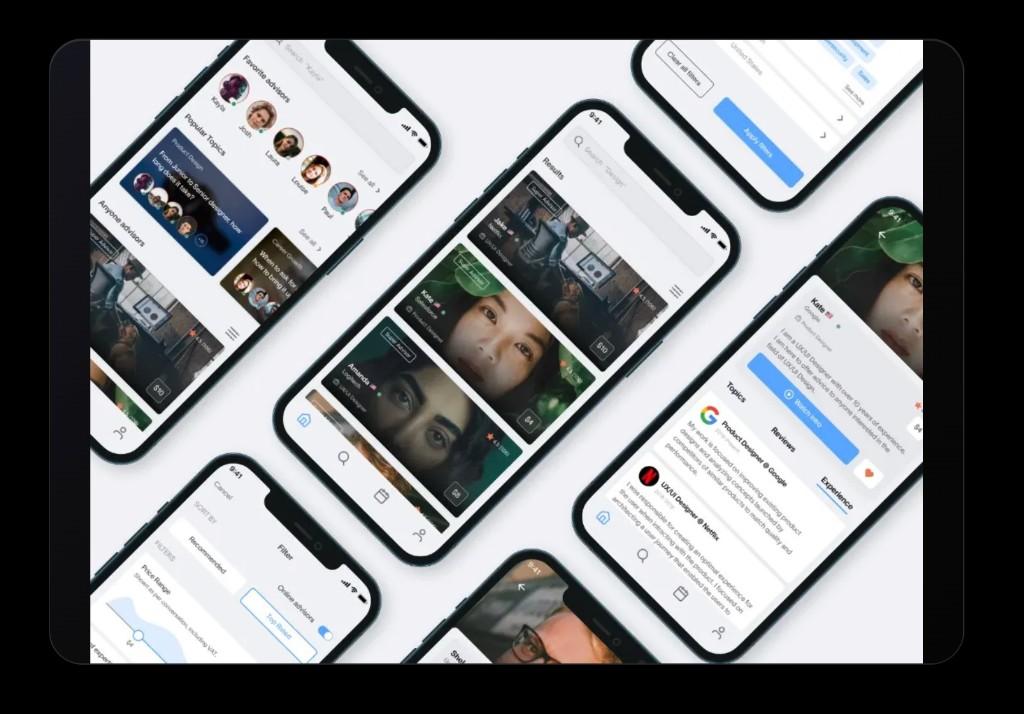
Prototype built for validation
I turned the flow into a high-fidelity prototype with realistic interactions, so the experience could be tested with users and evaluated against clear success criteria.
06 / VALIDATION
Testing the prototype with real users
I created a usability testing script with scenarios and tasks to evaluate whether the new flow helped users find and assess advisors more easily. The test focused on task completion, perceived usefulness of filtering, and whether the new experience made advisor discovery feel straightforward.
81.8%
Indirect success rate for the first task
88.9%
Direct success rate for the second task
90.9%
Found the filter option helpful
100%
Said the iteration made finding the right advisor straightforward
07 / REFLECTION
What this project demonstrates
The strongest part of this project was not the visual design itself, but the way the solution was shaped: starting from observations, validating the problem through research, prioritising opportunities, prototyping quickly, and testing the final direction with users.
Looking back, I would simplify the visual system and push the product strategy further, especially around trust signals, availability, and the moment where users are asked to commit. But the case study still demonstrates an important part of my design approach: using research and structured decision-making to reduce uncertainty in a product experience.
The outcome showed that even small changes to discovery, filtering, and profile information can make a high-consideration decision feel more straightforward.